PRICES WITH A TRACEABLE BASIS
Which market evidence supports a rental-building valuation?
Official average prices for individual apartments and houses are based on private-household purchases. They explicitly do not cover whole rental buildings. An apartment square-metre figure is therefore not multiplied into a blanket building value here. Relevant evidence includes supportable income, leases, costs retained by the owner, condition and transactions involving comparable investment properties.
What these figures mean and how they are produced
The statistics use purchases by private households from 2021–2025. Earlier transactions are model-adjusted to the 2025 price level. The published figures are geometric means, providing regional category benchmarks. They are not current asking prices or individual property valuations.
- Apartments and houses: district level. An individual municipality, micro-location, specification or condition can differ substantially.
- Building land: municipal figures are also published. Where transactions are sparse, the source groups municipalities. A district figure is a regional overview, not a replacement for a municipal figure.
- The category and area definition must fit. House figures already account for land through the plot-size category. These tables do not cover whole rental buildings or commercial properties.
Published 28 May 2026 · Reference year 2025 · Sources checked 13 November 2026. Missing values remain unavailable; they are neither estimated nor replaced with zero.
KNOWLEDGE FOR YOUR DECISION
Apartment building valuation in 1030 Vienna – Landstraße: tenancies, income and investment
An apartment building valuation in Vienna Landstraße requires more than annual rent and a yield figure. Connect the leases, actual receipts, running costs, vacancy and building condition. These establish supportable income and identify assumptions needing separate investigation.
Vienna Landstraße · Apartment building
Typical addressing postcode for orientation; some postal mappings cross district boundaries. Use each property’s actual address.
Weißgerber, Erdberg and Fasanviertel: defining a building comparison
The 3rd district brings together the historic areas of Landstraße, Erdberg and Weißgerber, alongside defined development areas such as Aspanggründe. For an apartment building valuation in Vienna’s 3rd district, location alone is insufficient: an existing investment building and a nearby new-build listing may have very different tenancies, building qualities and use possibilities.
- Evidence to prepare
- Describe the street section, front and courtyard wings, apartments, commercial premises and ancillary areas separately. Link each unit to its area, use, contract and actual condition.
- What this changes for your decision
- This identifies comparables that genuinely serve a similar purpose. A shared district name or proximity to a new quarter does not by itself establish equal rents or a fixed premium.
Reviewing residential and commercial income separately
The use mix forms part of the assessment of a Landstraße investment building. A street-level shop, courtyard apartment and later converted space cannot be explained by a single average rent. Contracted rent, payments actually received and an expected new rent answer different questions. The tenancy-law position also needs examination for each relevant unit.
- Evidence to prepare
- Date the rent roll and record contract commencement, use and area basis. Reconcile receipts and arrears; distinguish rent from operating-cost advances and other items.
- What this changes for your decision
- This shows whether a change in income comes from a contract, missed payment or merely a planning assumption. It is more meaningful than a blanket income comparison for the district.
Assessing vacancy and conversion ideas within the existing building
A vacant unit in Landstraße does not automatically provide immediately usable additional income. Establish why it is vacant, its handover condition and its documented use. Development at Aspanggründe describes a neighbouring quarter; it is not permission or a feasibility assessment for the owner’s building.
- Evidence to prepare
- Record the reason for vacancy, existing plans, building documents, required work and a justified timetable. For attic or use changes, document the status of each prerequisite.
- What this changes for your decision
- The assessment can distinguish the established position from a separate development scenario. Planned rent should not appear as current income while its costs and prerequisites are missing.
Documenting accessibility and access for each use
For Aspanggründe, the city identifies Vienna BioCenter/St. Marx station and specific walking and cycling routes. Buildings elsewhere in Landstraße have different routes. Check the usable connection from each actual entrance: residential access, shop access, deliveries and parking are not interchangeable.
- Evidence to prepare
- Record entrances, steps, lifts, passages and documented parking rights. Check routes to the relevant station on a plan and on site; travel or walking times need an identifiable basis.
- What this changes for your decision
- The location description becomes verifiable for individual units. Transport connections can be explained without claiming step-free access or private parking.
ONE PROPERTY. SPECIFIC QUESTIONS.
Reading a rent roll and vacancy together in Vienna’s 3rd district
Hypothetical review example. It explains an approach and is not a valuation of an actual property.
An apartment building in Landstraße contains let apartments, a commercial unit and a vacant unit. The owner suggests an expected rent for the vacancy.
- The evidence that makes a difference
- A dated rent roll, leases, payment records, floor plans, and the vacant unit’s condition and authorised use.
- How to interpret the evidence
- Existing receipts and expected receipts remain separate. A new-build listing near Eurogate does not establish an achievable rent for this unit. Work and time required before occupation also need clarification.
- The next useful step
- Base the assessment on the documented position; present any letting scenario separately with its assumptions professionally checked.
FROM EVIDENCE TO ASSESSMENT
Apartment building valuation: the questions behind the assessment
Local evidence and market data are set out above. These records help with the next property-specific checks; each link opens the complete explanation on the topic page.
Make the rent roll a verifiable valuation starting point
Match leases and amendments to individual units. Add a dated rent roll, payment records, arrears and explanations for area discrepancies or concessions.
Read the full check and its implicationsMove from rent receipts to sustainable net income
Provide accounts, costs actually borne by the owner, maintenance agreements and known works. Explain exceptional expenditure instead of silently removing it.
Read the full check and its implicationsAssess tenancy rules and indexation for each unit
Collect approval and subsidy records, lease commencement details, amendments, indexation clauses and the last adjustment actually implemented for each unit.
Read the full check and its implicationsEvaluate vacancy through cost, timing and permitted use
Record why a unit is empty, its inspected condition, approved use, known works and their estimated cost. Distinguish actual termination agreements from expectations.
Read the full check and its implicationsReflect building condition and maintenance needs in value
Collect invoices, work specifications, inspection reports, outstanding official orders and specific quotations. Link each item to the relevant building element and its current status.
Read the full check and its implicationsSeparate income value, development potential and valuation date
Identify the valuation purpose and date. Provide approved existing plans, actual project documents, known rights and the sources of comparable or income data.
Read the full check and its implicationsWELL PREPARED
Documents for your apartment building valuation in Vienna Landstraße
- Current rent roll and area schedule
- Tenancy agreements, amendments and terms
- Actual income and relevant expenditure
- Vacancy schedule with unit condition
- Land register, building plans and approvals
- Maintenance records and documented capital needs
Identify each detail as evidenced, estimated or unresolved. Relevant records are described alongside the questions above. This helps establish which missing information actually matters for your property.
For the wider region, see Apartment building valuation in Vienna.
The purpose forms part of the assessment. For inherited property, separation or financial changes a clear valuation date and shared information provide a useful starting point.
GEOGRAPHICAL CONTEXT
Vienna Landstraße: area and location at a glance
The boundary helps identify the area. For your property, the actual address, use and local questions discussed in this article remain essential.
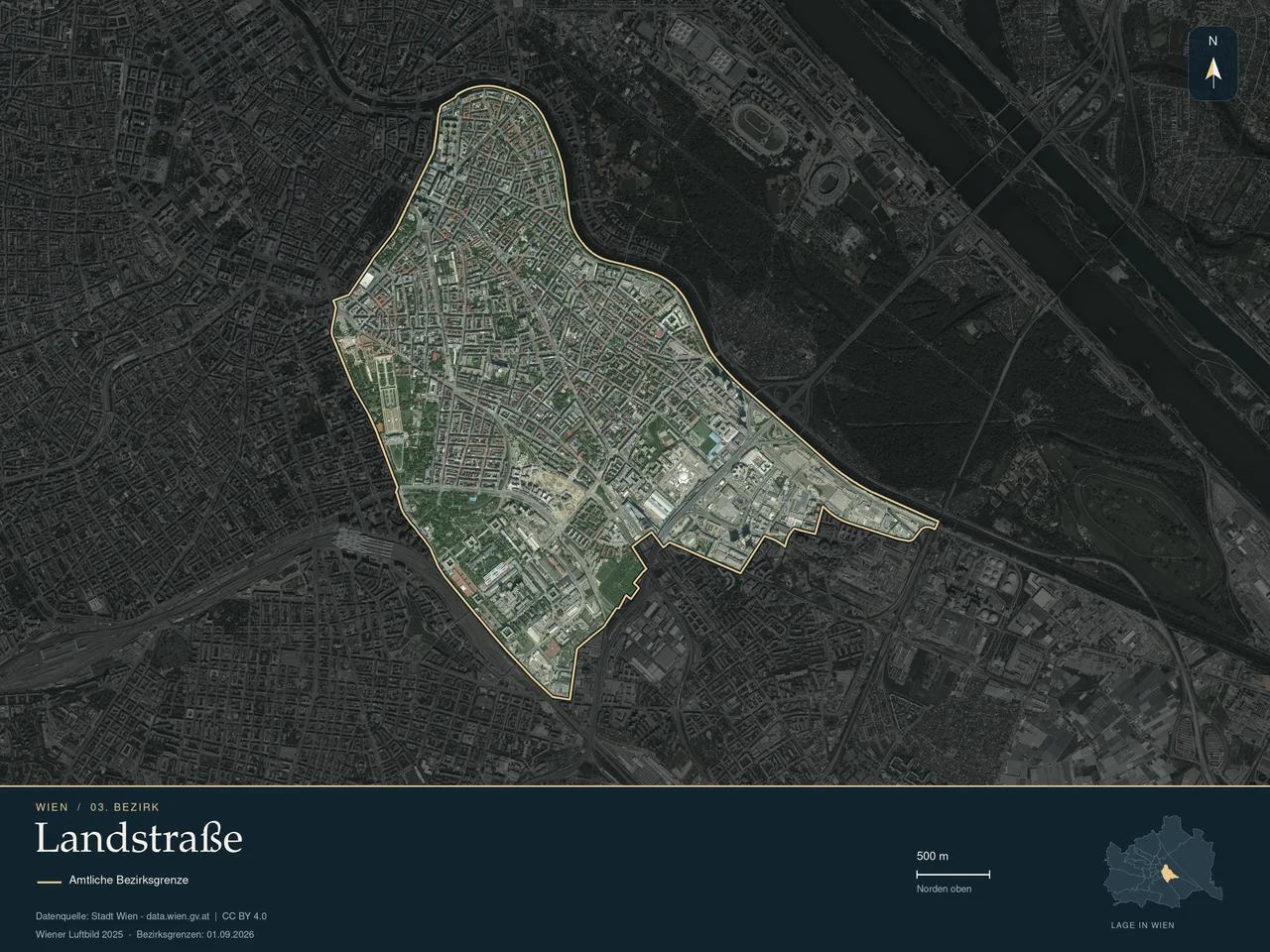
Area, coordinates & source data
Vienna Landstraße · Orientation point: 48.19376° N, 16.39608° E (WGS84).
The point is derived from the official boundary and lies inside the displayed area. It is neither an official town centre nor a business location. The map shows administrative boundaries; it does not establish property boundaries, zoning or property values.
Boundary reference date: 2026-09-01 · Complete boundary geometry (GeoJSON)
PRACTICAL ANSWERS FOR OWNERS
Questions about Apartment building valuation in Vienna Landstraße
Which parts of Landstraße matter when comparing my investment building?
Start with the actual street section and building structure. Whether Weißgerber, Erdberg, Fasanviertel or Aspanggründe, a useful comparison also needs a compatible use mix, condition and tenancy position. Proximity to a new development does not justify directly applying its asking prices or expected rents to an existing investment building.
What if my Landstraße building’s rent roll does not match receipts?
Compare amounts due with receipts by unit and for the same period. Check arrears, timing differences and ancillary charges. An up-to-date schedule alone does not prove full receipt of income. Record unresolved discrepancies so the assessment does not treat uncertain receipts as established.
Can I apply a Eurogate new-build rent to a vacant unit in my building?
Only after a justified comparison and property assessment. Area, features, condition, legal prerequisites and costs before letting must fit the unit. Show planned new letting separately from existing tenancies. Proximity to Eurogate does not make an advertised rent legally applicable or economically established.
Why does an investment-building assessment in 1030 Vienna need each unit’s area?
So income, use and expenditure refer to the same property configuration. Resolve differences between plans, leases and the rent roll. Communal areas, ancillary spaces and unverified conversions should not silently enter one lettable-area total. A clear area schedule helps allocate income and comparisons correctly.
How is proximity to St. Marx considered for my investment building?
Through usable routes and the needs of individual units. Identify access to the relevant station, steps, crossings and any delivery arrangements. General proximity is a location characteristic, not evidence of a particular walking time, step-free access or a private parking right.
Why is a price per square metre insufficient for rental-building valuation in Vienna Landstraße?
Buildings of similar size can have different tenancy rights, income and maintenance needs. A price per square metre may assist comparison but does not explain those differences. An income assessment examines what remains under the current and supportable future circumstances. Only then can a comparable building be judged economically similar.
Which rent-roll amounts should not simply be treated as net income?
Separate base rent, service charges, tax components and other payments. Deposits and one-off back payments are not automatically recurring rent. Then assess property-related expenditure and income-loss assumptions. The label annual rent does not establish whether a figure means gross receipts, base rent or an already adjusted income figure.
Do identical tenancy rules automatically apply to every unit in a rental building?
No. The Mietrechtsgesetz contains different applications and exceptions. Construction and approval history, subsidies, condominium ownership and the specific use may matter. A label such as historic or new building is insufficient. Establish the position for each unit or tenancy arrangement before drawing conclusions about permissible rent or termination.
Can a low existing rent be replaced with a higher advertised rent in the valuation?
A higher rent in an advertisement does not change the existing lease. Assess whether and when a different rent could legally and practically be achieved. Existing tenancy rights and any rent restrictions remain part of the valuation. If reletting is only a scenario, identify its conditions, cost and timing relative to the current position.
Should expected refurbishment costs automatically be deducted in full from value?
Not without checking how condition has already been reflected. An item may affect the income assumption, usability or a separate adjustment. The same limitation should not be counted twice. Clear works, costs and an explained valuation model are needed; a rough refurbishment total alone does not establish the change in value.
Does an assessment commit me to selling or appointing an agent?
No. You decide which step to take. A valuation or consultation enquiry does not appoint an agent. Any engagement, its services and its terms are agreed separately.
How does an agent introduction through ImmoWertAtlas work?
An introduction is made at your explicit request. A suitable contact depends on the property type, location and your plans. The requested introduction and the information needed for it are discussed with you first. You then decide whether to work together.
All apartment building valuation questions
Sources & supporting references20 sources
Legislation, official information and supporting references for the guidance on this page. How we assess sources and statements.
- Back to text
- Back to text
- Landstraße: historische Teilräume des Bezirkspresse.wien.gv.atBack to text
- Back to text
- Back to text
- Back to text
- Mietrechtsgesetz § 1 – Geltungsbereichris.bka.gv.atBack to text
- Back to text
- Mietzins · Bestandteile der monatlichen Zahlungoesterreich.gv.atBack to text
- Mietrechtsgesetz § 16b · Kautionris.bka.gv.atBack to text
- Back to text
- Mietrechtsgesetz § 3 · Erhaltungris.bka.gv.atBack to text
- Mietrechtsgesetz § 16 · Höhe des Hauptmietzinsesris.bka.gv.atBack to text
- Mieten-Wertsicherungsgesetzris.bka.gv.atBack to text
- Back to text
- Mietrechtsgesetz § 30 · Kündigungsbeschränkungenris.bka.gv.atBack to text
- Back to text
- Back to text
- Back to text
- Back to text
Knowledge
Read more about this topic
Residential investment buildings, rent rolls and income
How to organise tenancy terms, actual income and ongoing expenditure for sale and assessment.
Read guideUnderstanding a property assessment
Purpose, evidence and assumptions determine how useful a property value is.
Read guide