PRICES WITH A TRACEABLE BASIS
Which market evidence supports a rental-building valuation?
Official average prices for individual apartments and houses are based on private-household purchases. They explicitly do not cover whole rental buildings. An apartment square-metre figure is therefore not multiplied into a blanket building value here. Relevant evidence includes supportable income, leases, costs retained by the owner, condition and transactions involving comparable investment properties.
What these figures mean and how they are produced
The statistics use purchases by private households from 2021–2025. Earlier transactions are model-adjusted to the 2025 price level. The published figures are geometric means, providing regional category benchmarks. They are not current asking prices or individual property valuations.
- Apartments and houses: district level. An individual municipality, micro-location, specification or condition can differ substantially.
- Building land: municipal figures are also published. Where transactions are sparse, the source groups municipalities. A district figure is a regional overview, not a replacement for a municipal figure.
- The category and area definition must fit. House figures already account for land through the plot-size category. These tables do not cover whole rental buildings or commercial properties.
Published 28 May 2026 · Reference year 2025 · Sources checked 13 November 2026. Missing values remain unavailable; they are neither estimated nor replaced with zero.
KNOWLEDGE FOR YOUR DECISION
Apartment building valuation in 1010 Vienna – Innere Stadt: tenancies, income and investment
An apartment building valuation in Vienna Innere Stadt requires more than annual rent and a yield figure. Connect the leases, actual receipts, running costs, vacancy and building condition. These establish supportable income and identify assumptions needing separate investigation.
Vienna Innere Stadt · Apartment building
Typical addressing postcode for orientation; some postal mappings cross district boundaries. Use each property’s actual address.
Historic centre with defined zone boundaries
The core zone of Vienna’s Historic Centre World Heritage Site covers most of the first district, excluding the Danube Canal waterfront. It also includes adjoining parts of other districts. For an apartment building, document structural maintenance, use rights and rental income in their respective records.
- Evidence to prepare
- Connect building and renovation files with the let areas. Condition reports and specific cost estimates help for roofs, façades and windows; protection status and tenancies require separate review.
- What this changes for your decision
- This makes maintenance needs and actual alteration possibilities understandable. Historic appearance, municipal conservation areas and individual listed status must not be treated as identical.
Shared-space streets in Herrengasse and Rotenturmstraße
The City of Vienna lists Herrengasse and Rotenturmstraße as shared-space streets. Their public-space design and traffic organisation therefore differ from those of an ordinary through road. Apartments, commercial units and ancillary areas can have different access needs within one building.
- Evidence to prepare
- Review access to apartments, commercial units and deliveries separately. Document lifts, communal routes and any rights concerning passages or parking.
- What this changes for your decision
- An actual usable route can be explained in comparisons and sale particulars. Straight-line distance, general proximity to a station or street parking proves neither step-free access nor a private parking right.
Building and renovation file for the local property · apartment building
For an existing property in Innere Stadt, record the individual unit, communal parts and later alterations separately. Official neighbourhood descriptions provide context; building and management records must come from the actual building. A meaningful income picture requires identifiable areas, actual uses and reliable tenancy records.
- Evidence to prepare
- Reconcile the rent schedule and leases with approved plans, actual uses and renovation records. Keep unverified areas or uses separate until clarified.
- What this changes for your decision
- This separates documented condition and rights from assumptions. Outstanding information can be requested before valuation or marketing instead of implying that the file is complete.
FROM EVIDENCE TO ASSESSMENT
Apartment building valuation: the questions behind the assessment
Local evidence and market data are set out above. These records help with the next property-specific checks; each link opens the complete explanation on the topic page.
Make the rent roll a verifiable valuation starting point
Match leases and amendments to individual units. Add a dated rent roll, payment records, arrears and explanations for area discrepancies or concessions.
Read the full check and its implicationsMove from rent receipts to sustainable net income
Provide accounts, costs actually borne by the owner, maintenance agreements and known works. Explain exceptional expenditure instead of silently removing it.
Read the full check and its implicationsAssess tenancy rules and indexation for each unit
Collect approval and subsidy records, lease commencement details, amendments, indexation clauses and the last adjustment actually implemented for each unit.
Read the full check and its implicationsEvaluate vacancy through cost, timing and permitted use
Record why a unit is empty, its inspected condition, approved use, known works and their estimated cost. Distinguish actual termination agreements from expectations.
Read the full check and its implicationsReflect building condition and maintenance needs in value
Collect invoices, work specifications, inspection reports, outstanding official orders and specific quotations. Link each item to the relevant building element and its current status.
Read the full check and its implicationsSeparate income value, development potential and valuation date
Identify the valuation purpose and date. Provide approved existing plans, actual project documents, known rights and the sources of comparable or income data.
Read the full check and its implicationsWELL PREPARED
Documents for your apartment building valuation in Vienna Innere Stadt
- Current rent roll and area schedule
- Tenancy agreements, amendments and terms
- Actual income and relevant expenditure
- Vacancy schedule with unit condition
- Land register, building plans and approvals
- Maintenance records and documented capital needs
Identify each detail as evidenced, estimated or unresolved. Relevant records are described alongside the questions above. This helps establish which missing information actually matters for your property.
For the wider region, see Apartment building valuation in Vienna.
The purpose forms part of the assessment. For inherited property, separation or financial changes a clear valuation date and shared information provide a useful starting point.
GEOGRAPHICAL CONTEXT
Vienna Innere Stadt: area and location at a glance
The boundary helps identify the area. For your property, the actual address, use and local questions discussed in this article remain essential.
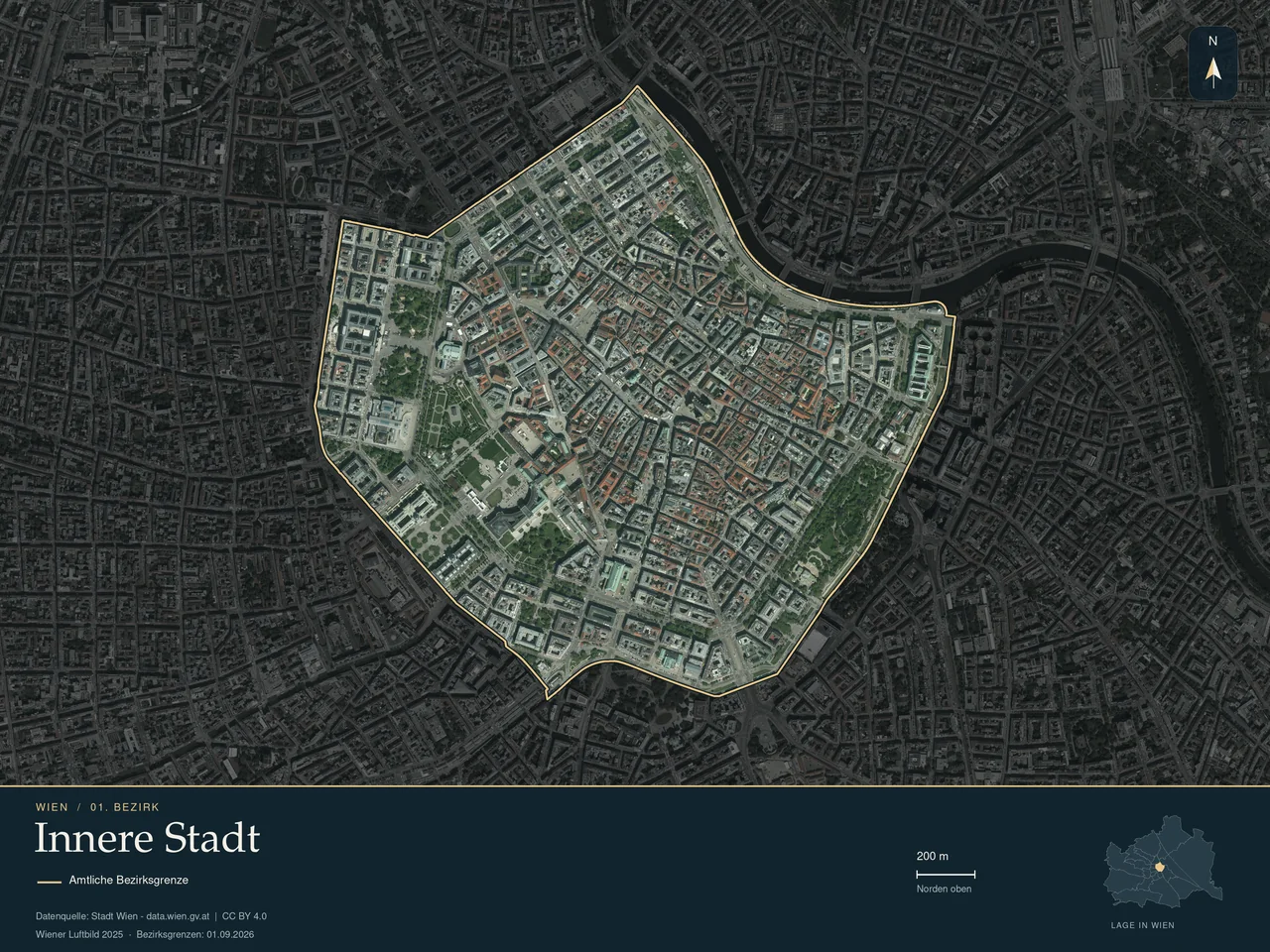
Area, coordinates & source data
Vienna Innere Stadt · Orientation point: 48.20836° N, 16.36940° E (WGS84).
The point is derived from the official boundary and lies inside the displayed area. It is neither an official town centre nor a business location. The map shows administrative boundaries; it does not establish property boundaries, zoning or property values.
Boundary reference date: 2026-09-01 · Complete boundary geometry (GeoJSON)
PRACTICAL ANSWERS FOR OWNERS
Questions about Apartment building valuation in Vienna Innere Stadt
How does the World Heritage zone affect the assessment of my apartment building?
The district boundary alone is insufficient, particularly along the Danube Canal waterfront. Locate the address on the official zone map, then assess any proposed alterations separately. List maintenance and tenancies separately; an attractive appearance does not replace reliable cost and income records.
How should I account for the shared street when assessing my apartment building on Herrengasse or Rotenturmstraße?
A shared-street designation does not establish an entirely car-free street. Check the current arrangements at the actual access point and describe vehicle access and observed street use separately. Check residential access separately from commercial deliveries; both must match the relevant let unit.
How do I check whether areas and rents for my apartment building in Vienna’s Innere Stadt district agree?
Why is a price per square metre insufficient for rental-building valuation in Vienna Innere Stadt?
Buildings of similar size can have different tenancy rights, income and maintenance needs. A price per square metre may assist comparison but does not explain those differences. An income assessment examines what remains under the current and supportable future circumstances. Only then can a comparable building be judged economically similar.
Which rent-roll amounts should not simply be treated as net income?
Separate base rent, service charges, tax components and other payments. Deposits and one-off back payments are not automatically recurring rent. Then assess property-related expenditure and income-loss assumptions. The label annual rent does not establish whether a figure means gross receipts, base rent or an already adjusted income figure.
Do identical tenancy rules automatically apply to every unit in a rental building?
No. The Mietrechtsgesetz contains different applications and exceptions. Construction and approval history, subsidies, condominium ownership and the specific use may matter. A label such as historic or new building is insufficient. Establish the position for each unit or tenancy arrangement before drawing conclusions about permissible rent or termination.
Can a low existing rent be replaced with a higher advertised rent in the valuation?
A higher rent in an advertisement does not change the existing lease. Assess whether and when a different rent could legally and practically be achieved. Existing tenancy rights and any rent restrictions remain part of the valuation. If reletting is only a scenario, identify its conditions, cost and timing relative to the current position.
Should expected refurbishment costs automatically be deducted in full from value?
Not without checking how condition has already been reflected. An item may affect the income assumption, usability or a separate adjustment. The same limitation should not be counted twice. Clear works, costs and an explained valuation model are needed; a rough refurbishment total alone does not establish the change in value.
Should an unconverted attic already be valued as completed residential floor space?
No. Existing space and residential accommodation that can legally and technically be created are different starting points. Clarify rights, approved plans, planning rules, structure, access and implementation costs. An evidenced project opportunity can be assessed separately. Otherwise, the valuation would assume a completed outcome while approval, construction and letting remain outstanding.
What if the rent roll and actual receipts do not match?
Allocate the difference to a unit and a period. Arrears, back payments, concessions or differently presented charge components may explain it. Record the cause rather than simply changing the total. A valuation needs to distinguish a lower contractual entitlement from an unpaid amount or a difference in accounting presentation.
Does an assessment commit me to selling or appointing an agent?
No. You decide which step to take. A valuation or consultation enquiry does not appoint an agent. Any engagement, its services and its terms are agreed separately.
How does an agent introduction through ImmoWertAtlas work?
An introduction is made at your explicit request. A suitable contact depends on the property type, location and your plans. The requested introduction and the information needed for it are discussed with you first. You then decide whether to work together.
All apartment building valuation questions
Sources & supporting references20 sources
Legislation, official information and supporting references for the guidance on this page. How we assess sources and statements.
- Back to text
- Back to text
- Back to text
- Back to text
- Laufende Aufwendungen des Wohnungseigentümersoesterreich.gv.atBack to text
- Aufgaben der Hausverwaltung bei Wohnungseigentumsobjektennoe.arbeiterkammer.atBack to text
- Back to text
- Mietzins · Bestandteile der monatlichen Zahlungoesterreich.gv.atBack to text
- Mietrechtsgesetz § 16b · Kautionris.bka.gv.atBack to text
- Back to text
- Mietrechtsgesetz § 3 · Erhaltungris.bka.gv.atBack to text
- Mietrechtsgesetz § 1 – Geltungsbereichris.bka.gv.atBack to text
- Mietrechtsgesetz § 16 · Höhe des Hauptmietzinsesris.bka.gv.atBack to text
- Mieten-Wertsicherungsgesetzris.bka.gv.atBack to text
- Back to text
- Mietrechtsgesetz § 30 · Kündigungsbeschränkungenris.bka.gv.atBack to text
- Back to text
- Back to text
- Back to text
- Back to text
Knowledge
Read more about this topic
Residential investment buildings, rent rolls and income
How to organise tenancy terms, actual income and ongoing expenditure for sale and assessment.
Read guideUnderstanding a property assessment
Purpose, evidence and assumptions determine how useful a property value is.
Read guide